
It’s often considered best practice among architects and builders to let location inform design so that a home doesn’t just exist on the land where it’s built but rather co-exists with the land it’s built on. This was precisely how architect Kimberly Peck approached her recent project when her Manhattan clients called on her to design the architecture and interiors of their second home in the Catskill Mountains. “The homeowners wanted something distinctly modern and minimal, but warm enough to sink into for a week without it feeling precious,” says Peck. “That’s a departure from much of the traditional Catskills vernacular, which often leans rustic or farmhouse.”

The inspiration: Ticetonyk Mountain. The house sits on a slope of the mountain with long views in one direction and tree-covered rock face in the other. With such a dramatic backdrop, Peck felt the house should be quiet and minimalist rather than trying to outshine nature’s striking beauty. But the environment came into play for more than just the curves and edges. Weather in the Catskills can be unforgiving in winter, with bitter cold and little sun, so Peck worked with Rainbow Home Improvement to build the home to maximize light and hold interior temperatures steady. She had the builder position the house on the property to draw in low-lying sunshine, optimizing windows and selecting a triple pane design. For the floors, concrete acts as a thermal mass, holding the day’s heat and slowly giving it back over night. With these decisions, Peck was able to create “a tight envelope to keep the interior steady without working too hard.”


As an architect, Peck educates clients on the importance of making these early decisions, which shape how a house feels and how it lives. “Where the light falls, how the envelope performs—those happen first and quietly,” says Peck. “By the time you’re picking tile, the house has already decided whether it’s going to be comfortable in any season. You feel it when you walk in, even if you can’t point to why.”
It’s why she emphasizes with clients that they invest letting the professionals spend time working on orientation, envelope and insulation: three keys to a home’s design that are invisible to the untrained eye but vital to a home’s performance. If a mountain house is sited well, it draws low winter sun and holds warmth in cold temperatures. Durable natural materials weather over time but don’t wear out. “The goal is a house that feels steady in February, not one that needs attention,” says Peck.

Inside, her design is one that is meant to allow the homeowners to live symbiotically. “You arrive, you put things down, you cook, you move between rooms without bumping into each other,” says Peck. For this weekend and winter escape, the kitchen anchors everything.
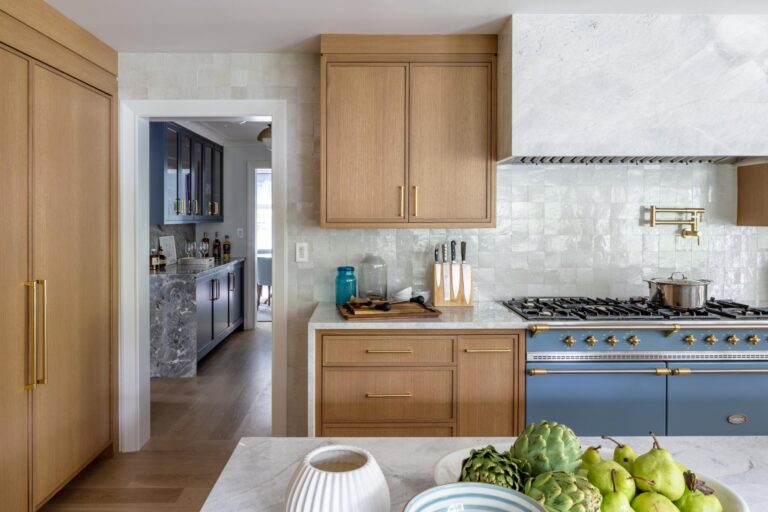
Materials like cedar, walnut, plaster and concrete wear well and warm up over time, advises Peck. She designed the open concept kitchen and living room with large sliding doors that walk directly “into the trees,” she says. Walnut cabinetry pairs with concrete flooring. A large island for prep overlooks the dining table with 180-degree views of the hills outside. Walnut cabinetry extends into the living room for media storage for a seamless transition. She designed the primary bedroom with its own private walk-out to the outdoor decking and a serene en suite bathroom with floor-to-ceiling views of the forest. “For a house like this, that kind of ease matters.” When family and friends come to visit and it is full, it functions to accommodate, and when the couple is there alone, it’s calm and peaceful.

“The feel matters as much as the performance,” says Peck, emphasizing how the view of the surrounding trees creates intimacy whether they are bare or in full foliage for summer. While the design is distinctly modern and minimal, she adds, “it doesn’t feel like a statement.”
“When you’re here in the morning with coffee and the light coming through the trees, you’re not thinking about architecture,” says Peck. “You’re just there. That’s hard to get right.”
Photos by Hanna Grankvist