Yena Jung, founder of By Yena Designs, has lots of experience making design decisions. The banking-analyst-turned-event-planner-turned-interior-designer, at every turn of her career, has leveraged her skill at interpreting her clients’ needs and wants to help them achieve their goals in a way they couldn’t dream possible. So, when she took on the challenge of redesigning her own family’s home in Larchmont, NY, it took her by surprise how challenging it was to make decisions that were all her own. “When it was my own home, I kind of had all the same feelings my clients do. The shoe was on the other foot,” muses Jung sitting down with 365 Collective to discuss what turned out to be one of the most challenging and personal projects to date.
When Jung and her husband began their pandemic-era home search, competition was steep and prices were high, so they decided to take on a fixer upper. Jung didn’t want to do a total renovation with two small children at the time, so she and her husband found one that felt “right.” “We’d walk in and I’d tell my real estate agent immediately, ‘It’s not my house.’ And she’d look at me like, ‘What are you talking about? You only took one step in the door,’” says Jung, who was looking for “open enough” but not open-concept. “I wanted a first floor where my kids could run in circles through the kitchen and around to the other parts of the house,” states Jung simply. Finding a framework that worked with her vision proved essential to the finished results. While her ideas were plentiful, their budget was smaller than that of her clientele. The project unfolded thoughtfully and in stages.
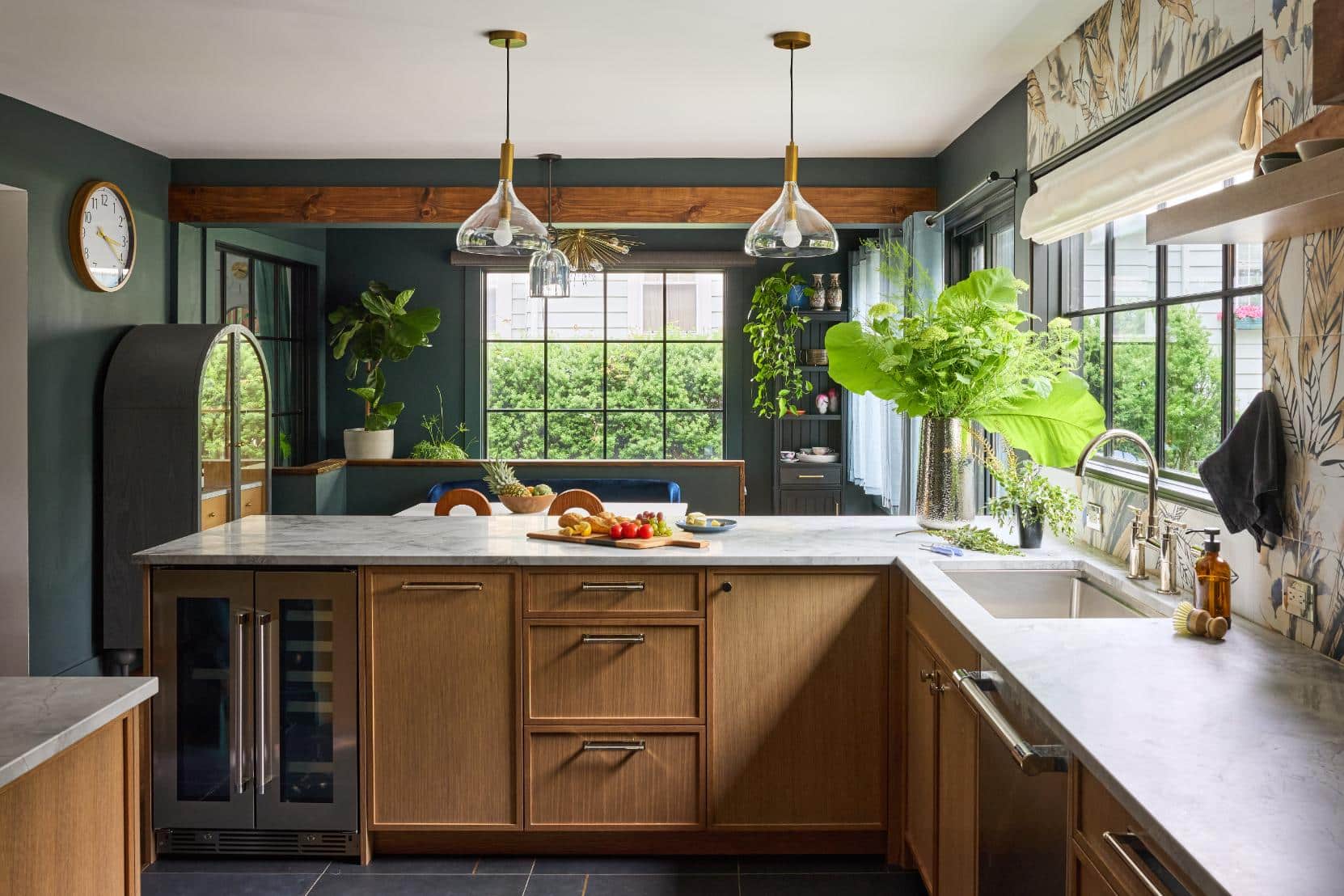
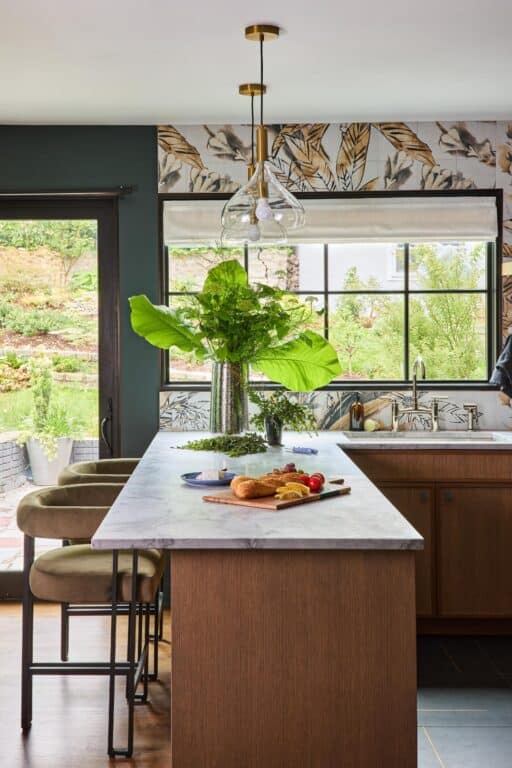
First things first, they focused on the kitchen, the heart of the home for most families. She knew they wouldn’t do another renovation for a long time so she wanted it to be something they would love for decades to come. Custom white oak unfinished cabinets came first. Then she searched for just the right backsplash tile and countertop. She found a tile with a foliage pattern on it that had gold, camel, navy and a little green in the leaves set on an ivory backdrop. “It was every color we wanted,” says Jung. “Then I backed into the cabinet color by testing out different stains.” She ended up mixing colors to find the perfect tone for the cabinets to go with the tile. The stone countertop has just-right veining to match. Making one big decision that you can’t go back on, actually helps you navigate the rest of the design decisions, advises Jung: “Every decision you make from the most expensive all the way down to the most simple item, [those decisions] were made because I had made the decision that came before it, and then it presented maybe two more options that really made it work. Then based on option A or B that, then, led to two other options. But there was never any going back or having regret about a decision, just by following this process.”
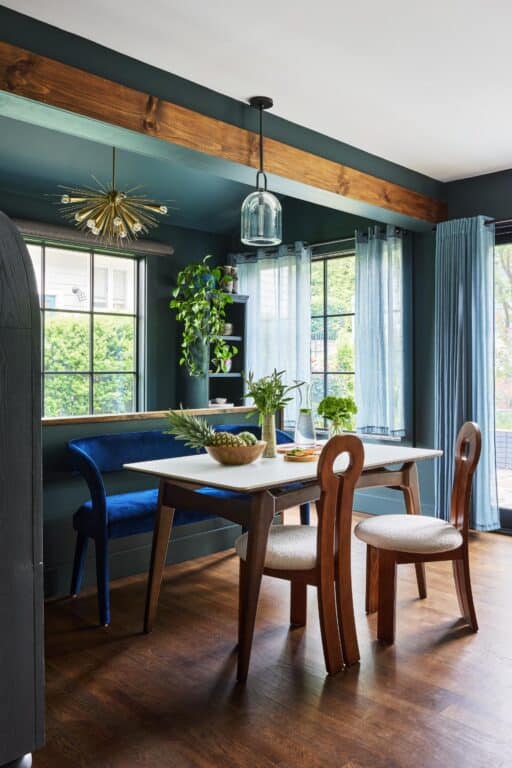
Before she chose cabinets, she had considered a green kitchen. Since green was out of the running in the kitchen, Jung decided to choose a shade of her husband’s favorite color for the adjacent dining room. An architectural natural wood beam and some modern furniture, including an eclectic table and chairs from Hernest Furniture, break up the color-drenched space with warm wood tones and a pop of blue. A gold starburst ceiling light from West Elm complements the gold hardware and lighting in the kitchen.
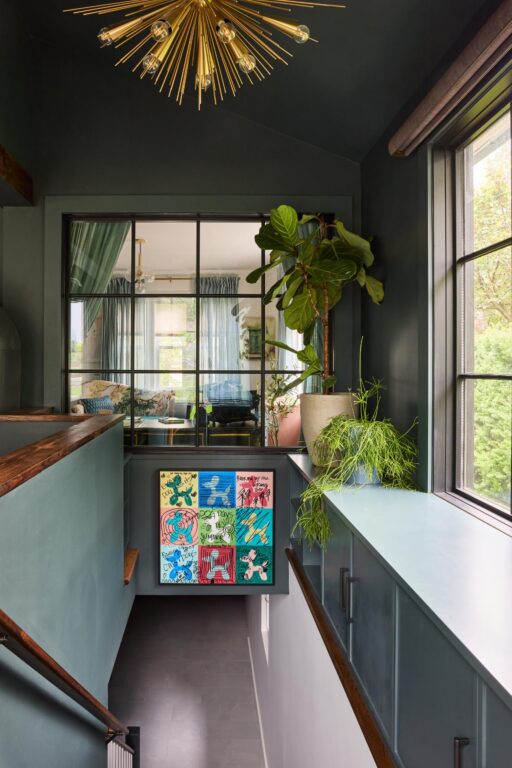
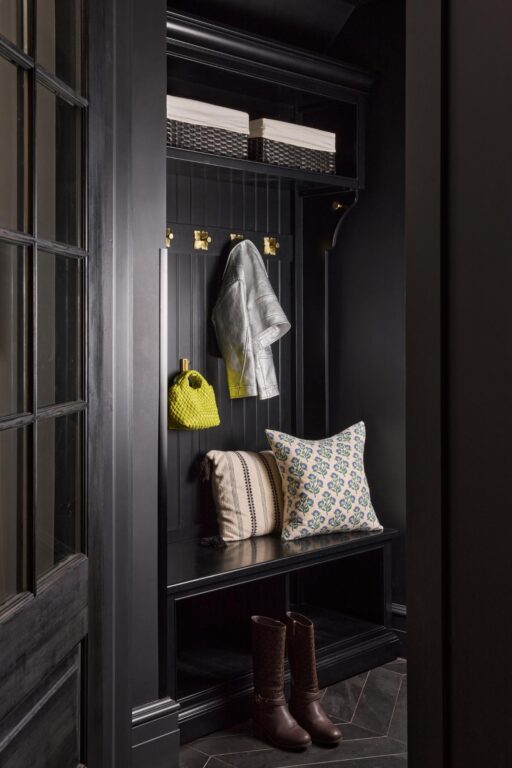
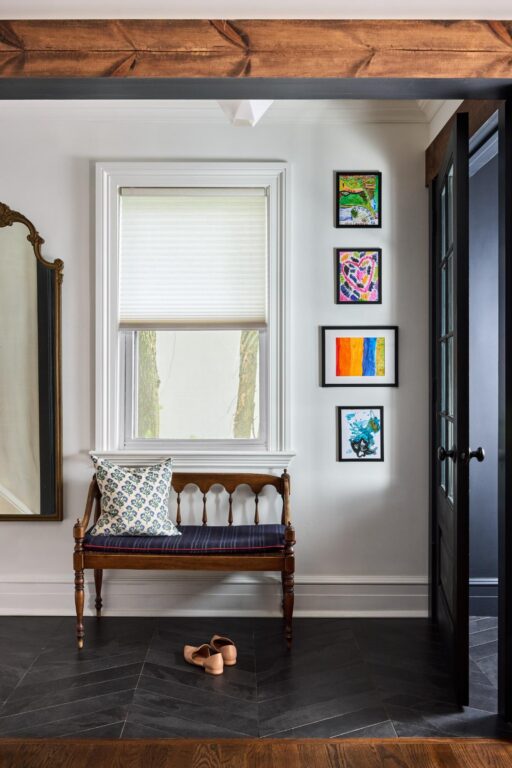
In the front hall, Jung painted the walls and moldings in black. A herringbone slate gray tile from Quality Tile in Bronx, NY, carries through the French door to the rest of the hallway. Jung accented the simple space with her children’s artwork and a thrifted bench.
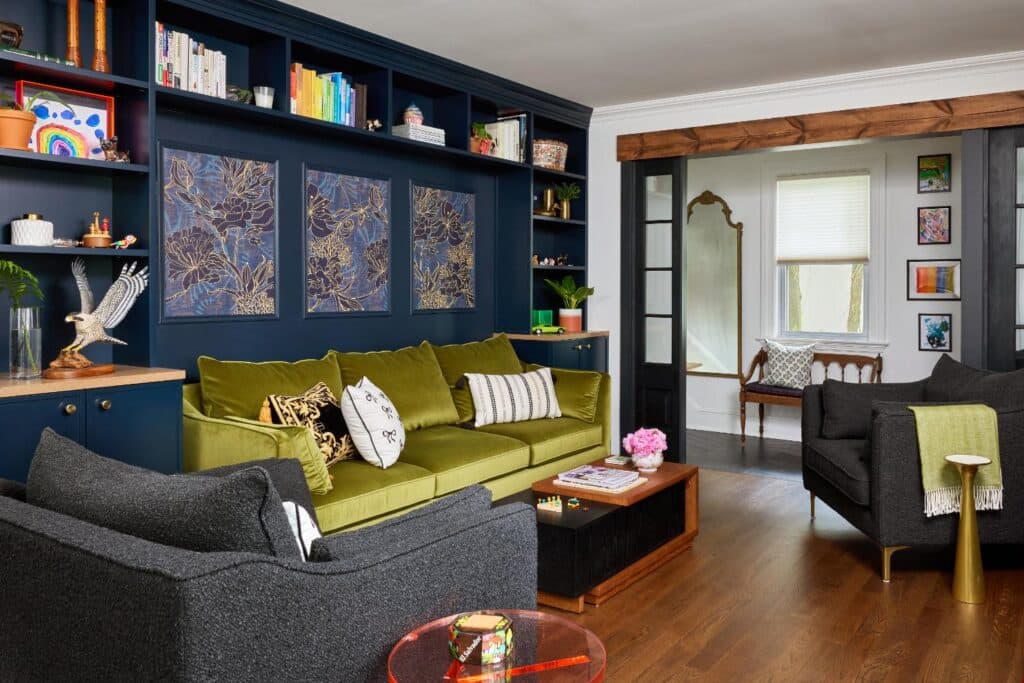
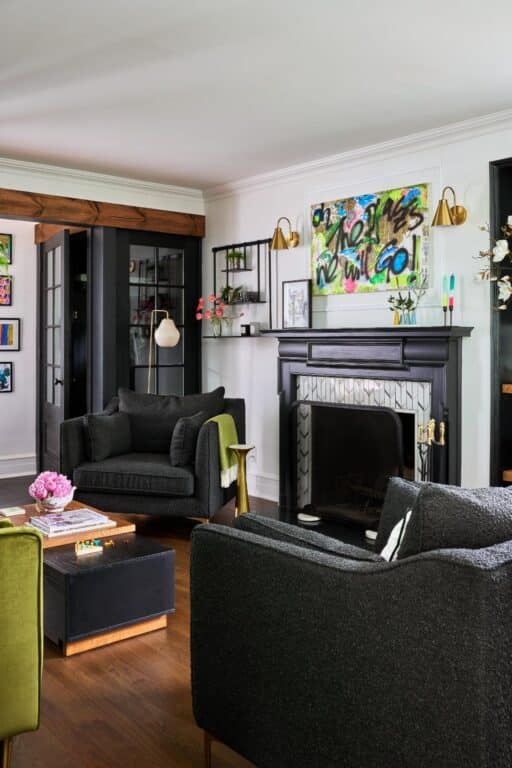
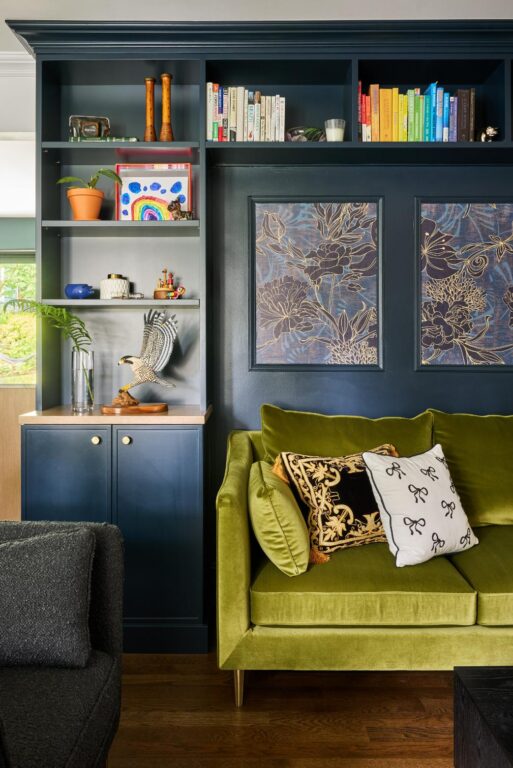
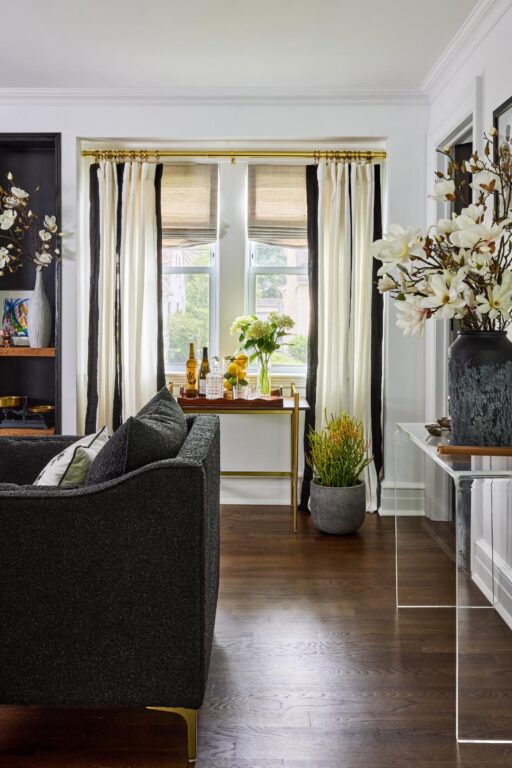
In the living room, Jung wanted more deep color to complement the black of the front hall but didn’t want to do more black, so she chose a navy blue. A green velvet sofa from Interior Define sets the right tone. “As a designer, I’m always telling clients they can’t put a couch up against the wall, so what am I doing, I put my couch against the wall,” laughs Jung. The space was too narrow to pull it off the wall, but some custom built-in shelving surrounding the sofa made the positioning feel intentional. Jung chose gold sconces and more art from her children to hang above the black and white fireplace.
“Green kept popping up in every room,” says Jung, who advises clients to weave a thread of continuity through any design project. The living room plays on shades of green with a more feminine bent. Turquoise striped drapes and a sofa from Anthropologie pair with an antique writing desk. A blue dresser from Hernest Furniture is paired with white and pink accent pieces. The pink and black silhouette artwork is a mixed media piece that Jung helped the kids create by painting and drawing over artwork found at Home Goods.
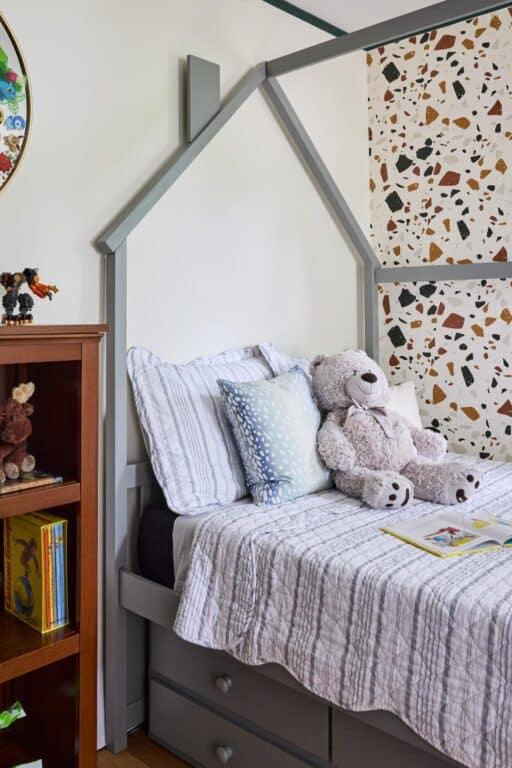
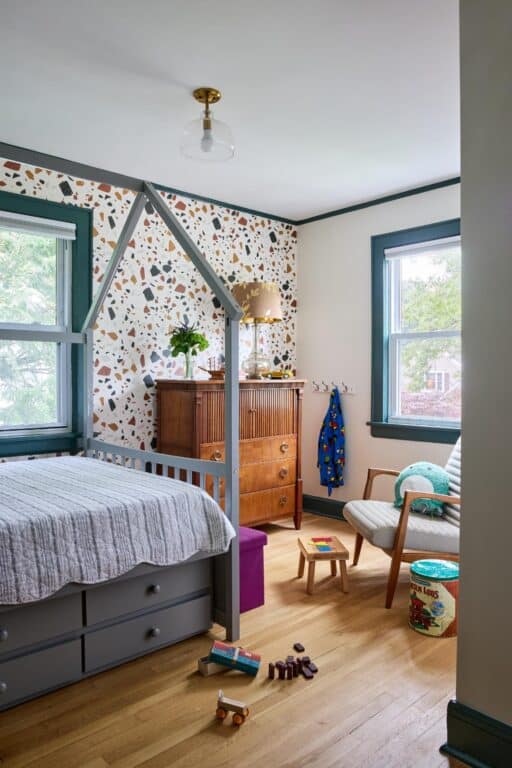
Upstairs in the bedrooms, she let the kids make design choices, but only after she narrowed down their options. “My son picked out his wallpaper, but it read a bit adult,” says Jung. There was red, black and green in the pattern, so she painted the trim in the room a soft green to give it a more youthful feel and paired the gray bed frame with an antique dresser and modern accent chair—both Facebook Marketplace finds.
In her daughter’s room, green-blue drapes and blue trim work bring out the blues in her floral wallpaper from ThinkNoir. A feminine light fixture from Shades of Light will grow with her and coordinates with a coral nightstand. “My daughter said, ‘Can you get me a colorful side table?’” says Jung recalling how she brought each element together. “Asking a child what she wants doesn’t mean she is going to tell me she wants it to be bright coral but for them to be able to say, ‘I want it to be colorful,’ that already narrows it down. It’s not white, it’s not black, it’s not pale blue.” She found the side table at Home Goods, repaired a broken leg and painted it a bright coral.
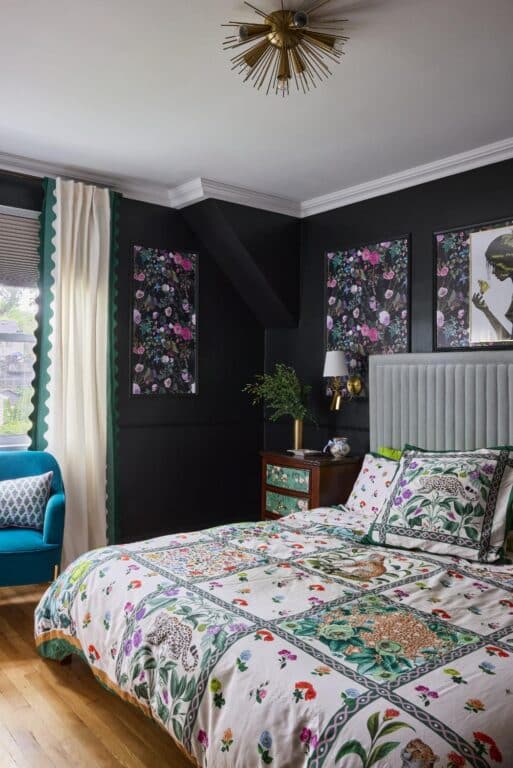
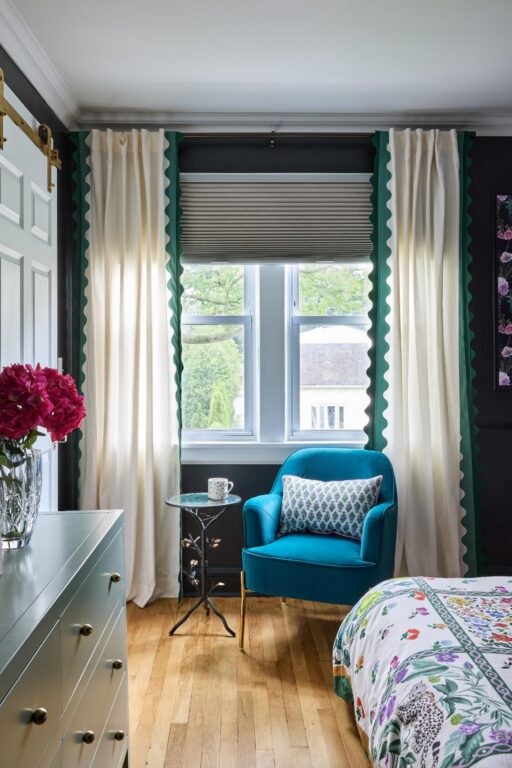
In the primary bedroom, Jung frames a floral wallpaper from Etsy maker HomeMood against a black painted wall for a bit of interest. An upholstered gray headboard and floral bedding pair with ivory Anthropologie drapes with scalloped ribbons of green. A teal accent chair and delicate iron side table provide the perfect spot to contemplate the day’s outfit while having morning coffee. A soft sage dresser picks up a color in the wallpaper. Jung bought nightstands from Facebook Marketplace and custom finished them with floral wallpaper in a different color than the wall. Then, she selected gold wall sconces to flank the bed.
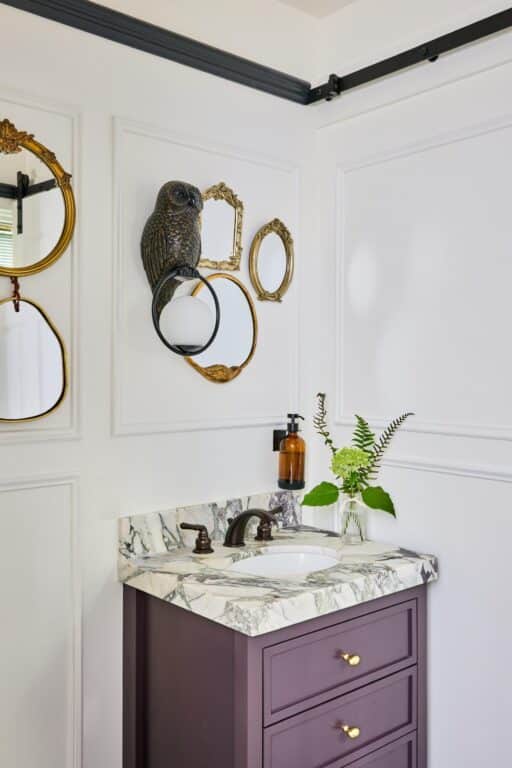
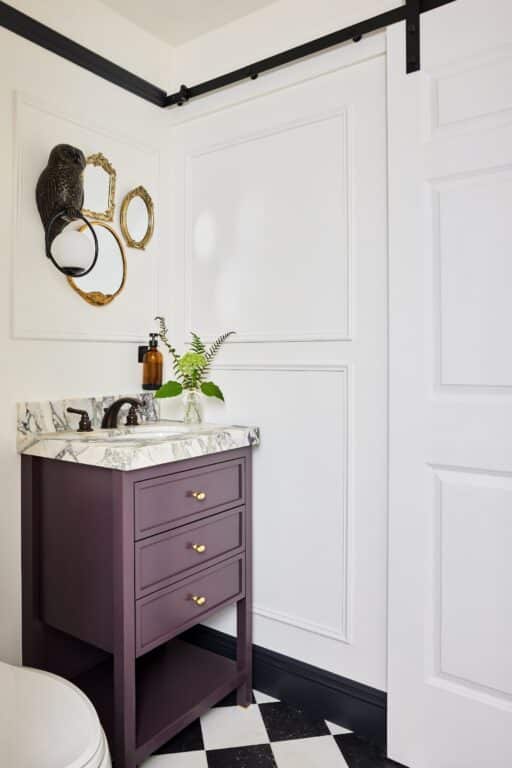
A small powder room on the first floor was the last room they finished. A deep lilac vanity with a marble top and black and white floor tiles pop against the white wall paneling. A collection of antique mirrors is playful and elegant rather than hanging one big mirror.
Having gone through the design process on her own home, Jung says it makes her better equipped to understand what her clients are going through and how difficult the decision-making process can be. But making decisions one at a time, browsing ideas online or in books, and getting input from family and friends, can all help you process your own design taste. “Even if you don’t agree on someone else’s opinion, the wrong advice can be enough sometimes because it can make you realize what you don’t want,” says Jung. She notes that she stores ideas and photos not to reuse but rather for inspiration. “I think what I do is store the feeling of it,” says Jung. “I look at it and think, ‘Oh that’s interesting. I wouldn’t necessarily have thought of this pattern with this texture with this color,’ and then move on from it. I store the sensation it brought me.”
Ultimately, Jung says, a home should reflect the people who live there, and humans are “supposed to have flaws and weirdness.”
“I know my house is not cookie-cutter by any stretch of the imagination,” says Jung, who puts her decision-making skills to work every day for her clients with their personality and interests in mind. She says she won’t recommend marble everywhere because it’s expensive. She recommends each piece to her clients to enhance the character of their home and reflect what’s meaningful to them in a way they might be afraid to do without a designer’s expertise.
“Design should almost scare you,” advises Jung. “If you’ve never done this before, you shouldn’t be hearing suggestions from me where you feel safe. Your job is to look for things that are safe and if I don’t push you at all…that’s a disservice to you.”
Photo Credit Kristen Francis